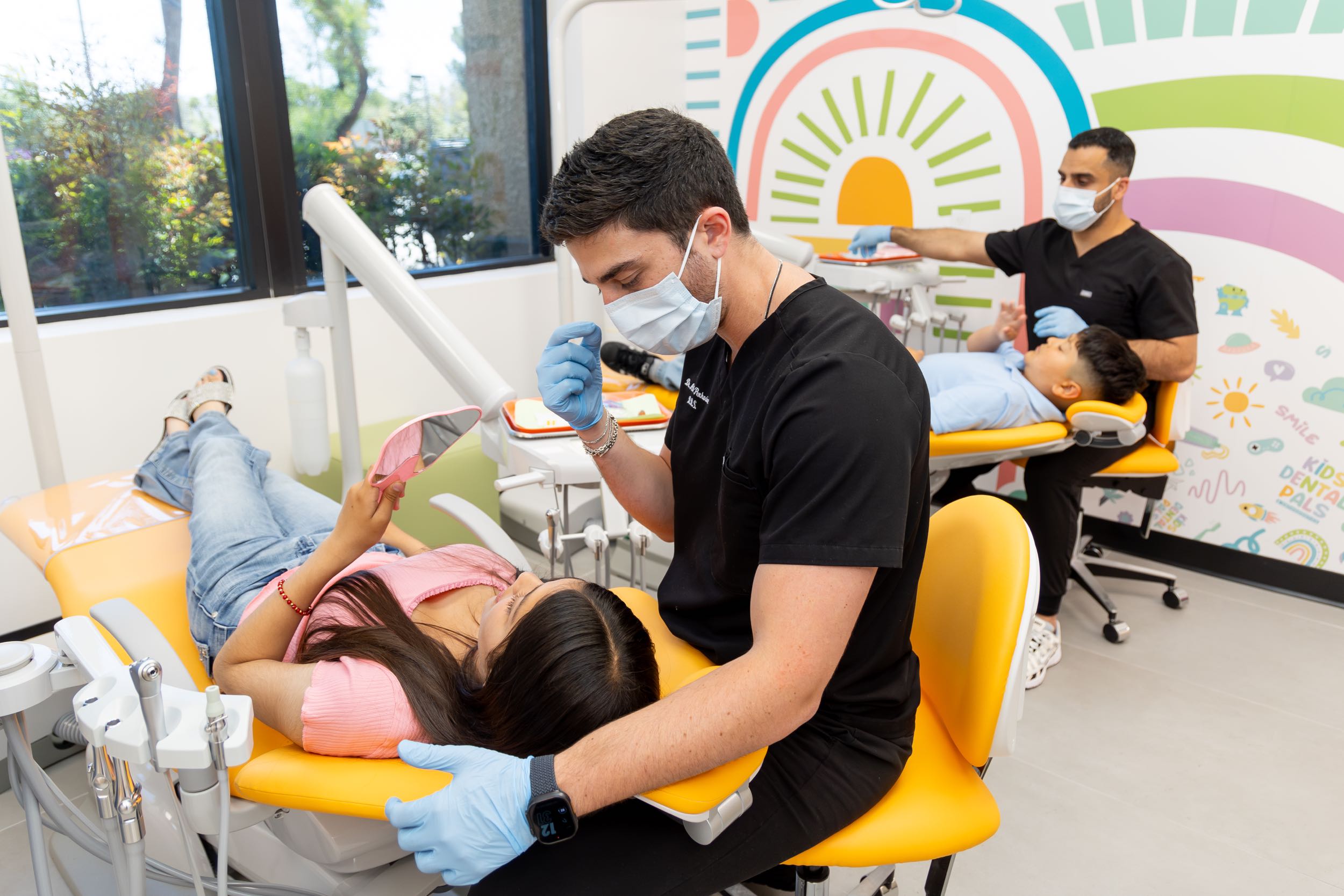
Schedule a complimentary orthodontic consultation and discover how we can help your child’s smile shine bright.
Invisalign straightens teeth using a series of custom-made, removable clear trays instead of brackets and wires. Each tray moves the teeth a small amount, and your teen switches to the next one on a schedule set by Dr. Ronnie. For teens who feel self-conscious about how braces look, Invisalign can be an appealing alternative — but it only delivers results if the trays are actually worn.
At Kids Dental Pals & Orthodontics, Dr. Ronnie evaluates every teen individually to determine whether Invisalign or braces will produce the better result. She also evaluates appropriate older children and adults for Invisalign, though this page focuses on treatment for teens.
Get a Complimentary Orthodontic Consultation
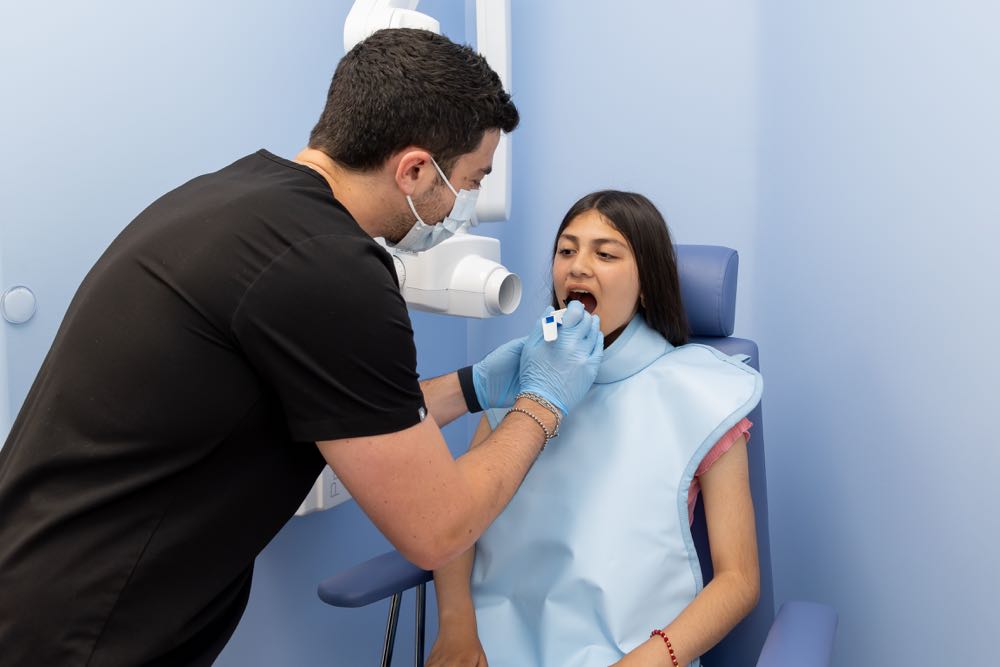
Invisalign vs. Braces
Neither option is automatically better. Braces and Invisalign are different tools, and the right one depends on your teen’s bite, the complexity of the case and — honestly — how reliably your teen will wear a removable tray. Here is a straight comparison, including the places where Invisalign is the weaker choice.
| Invisalign | Braces | |
|---|---|---|
| Visibility | Clear trays, noticeable up close. Attachments show as small tooth-colored bumps. | Visible brackets and wires, though colored bands let teens personalize them. |
| Removability | Removed for eating, brushing, sports and photos. | Fixed in place. Nothing to lose, forget, or leave in a napkin. |
| Food restrictions | None, because the trays come out to eat. | Hard, sticky and chewy foods must be avoided to protect the brackets. |
| Hygiene | Brushing and flossing are normal, but teeth must be brushed after every meal before the trays go back in, and the trays need cleaning too. | Requires careful brushing and flossing around brackets and wires, usually with threaders or a water flosser. |
| Compliance | The deciding factor. Treatment only progresses if the trays are worn 20–22 hours a day. A teen who forgets them will not get the result. | Works around the clock whether or not your teen remembers. Compliance is largely removed from the equation. |
| Emergency visits | No brackets to break or wires to poke, so unplanned repair visits tend to be less frequent. | Loose brackets and poking wires do happen and need a repair visit. |
| Complex cases | Limited. Significant bite correction, large rotations and teeth needing substantial vertical movement are often better handled with braces. | Handles the widest range of cases, including complex bite and skeletal problems. |
| Appointment experience | Check-ins to confirm the teeth are tracking, plus handover of the next sets of trays. | Adjustment visits where wires are changed. Teeth are often sore for a few days afterward. |
We will not tell you that Invisalign is always faster, easier or more comfortable than braces. For some teens it is an excellent fit. For others, braces will produce a better result in less time. Determining which is which is exactly what the consultation is for.
Who Makes a Good Teen Invisalign Candidate?
Dr. Ronnie looks at two separate things: whether the case is treatable with aligners at all, and whether the teen will realistically wear them.
Invisalign tends to work well for a teen who:
- Has mild to moderate crowding, spacing or alignment problems
- Has most or all of their permanent teeth in place
- Is motivated by the look of clear trays and wants to be involved in their own treatment
- Can keep track of a removable appliance — and remember to put it back in after lunch at school
- Has a parent willing to check in on wear time, at least in the early weeks
Braces may be the better recommendation when a teen:
- Has a significant bite problem, severe crowding, or teeth that require complex movement
- Is still waiting on permanent teeth to erupt
- Has already shown a pattern of losing retainers, mouthguards or similar removable items
- Is unlikely to reach 20–22 hours of daily wear without a nightly argument at home
There is no penalty for being honest with us about that last point. A teen who will not wear aligners is not a failure — they are simply a braces patient, and it is far better to establish that on day one than nine months in.
How Many Hours a Day Must the Aligners Be Worn?
20 to 22 hours a day. In practice, that means the aligners are in the mouth at all times except when eating, drinking anything other than water, and brushing. Across a normal school day, that leaves roughly two hours of total “out” time for all meals combined.
What Happens If Your Teen Does Not Wear Them Enough
This is the most common reason teen Invisalign treatment goes off course, and it is worth being blunt about.
- The teeth stop tracking. Each aligner is manufactured to fit the teeth in a predicted position. If the teeth have not moved as planned, the next tray will not seat properly — it will feel tight, lift away from the back teeth, or not go on at all.
- Treatment time stretches out. Missed wear time does not simply pause progress. It can mean going back to an earlier tray or re-scanning for an entirely new set of aligners.
- Refinement trays may become necessary to correct what did not move, adding months to the treatment.
- We may recommend switching to braces. If the wear time cannot be sustained, continuing with aligners wastes your money and your teen’s time. Dr. Ronnie will tell you plainly when it is time to change course.
We check tracking at every visit, so these problems surface early rather than at the end of treatment.
Eating, Drinking and Cleaning with Invisalign
Eating and Drinking Rules
- Take the aligners out to eat. Anything, every time. Chewing with the trays in can crack or warp them.
- Water is the only thing safe to drink with the aligners in.
- No hot drinks with the trays in — heat can distort the plastic.
- Sugary and acidic drinks are a genuine risk. Soda, juice, sports drinks and sweetened coffee get trapped against the enamel underneath the tray, which can cause decay and white-spot decalcification.
- Coffee, tea and curry will stain the trays. Take them out first.
- No chewing gum with the aligners in.
Brushing and Flossing
- Brush and floss before the aligners go back in after every meal. Sealing food and plaque against the teeth for hours at a time is how cavities start during aligner treatment.
- A travel toothbrush in the backpack makes school lunch manageable. Without one, most teens simply skip this step.
- Rinse the aligners in lukewarm water whenever they are out, and clean them daily with a soft brush and clear, unscented soap.
- Do not use toothpaste on the trays — it is abrasive and clouds the plastic. Do not use hot water, and never put them in the dishwasher.
Because our pediatric dental team works inside the same practice, your teen stays on their regular cleaning schedule throughout Invisalign treatment, and our hygienists can catch early hygiene problems before they turn into cavities.
Invisalign Attachments and Elastics
Attachments
Attachments are small, tooth-colored bumps of dental composite bonded onto certain teeth. They give the aligner something to grip, so it can push or rotate a tooth in a way that a smooth tray simply cannot.
- They are placed at the start of treatment and removed at the end.
- Placing them is not painful and involves no drilling.
- They are the main reason people can tell a teen is wearing aligners. This is worth knowing up front, since many families assume Invisalign is completely invisible.
- Most Invisalign cases use them. They are not optional if Dr. Ronnie has planned for them.
Elastics
Elastics (rubber bands) hook between the upper and lower aligners to correct the way the jaws meet — overbites, underbites and crossbites. Aligners are very good at moving individual teeth, and less able on their own to change the relationship between the two jaws.
- If elastics are prescribed, they need to be worn as directed, which is typically almost full time.
- They are changed daily, and your teen will be shown exactly how to place them.
- Skipping elastics stalls the bite correction even when the aligners themselves are being worn faithfully.
What If an Aligner Is Lost or Broken?
It happens, usually wrapped in a napkin at a restaurant. Here is what to do:
- Call us right away. Do not wait until the next scheduled visit.
- Put the previous aligner back in immediately if you still have it. This holds the teeth where they are and stops them drifting back. It is exactly why we tell families to keep the last set rather than throw it away.
- Do not skip ahead to the next tray unless we tell you to. If the teeth have not finished the current step, the next tray will not fit, and forcing it causes pain and poor tracking.
- Dr. Ronnie will decide whether to move forward, re-wear a stage, or order a replacement aligner.
Depending on where your teen is in treatment, a replacement aligner may involve a fee and a wait while it is manufactured — so keeping the trays in their case, rather than a napkin or a pocket, is genuinely worth the nagging.
Problems Invisalign Can Treat — and When Braces Are the Better Option
Commonly treated with Invisalign
- Crooked or crowded teeth
- Gaps and spacing
- Mild to moderate overbite, underbite, crossbite and open bite
- Relapse after earlier orthodontic treatment
- Cases where the teen has all, or nearly all, of their permanent teeth
When Dr. Ronnie may recommend braces instead
- Severe crowding or spacing, or cases that require extractions and significant tooth movement
- Significant skeletal or bite discrepancies that need more force than a removable tray can apply
- Teeth requiring large rotations or vertical movement, such as canines and premolars, which aligners struggle to grip
- Teeth still erupting, where a fixed appliance adapts better than a tray manufactured for teeth that have since moved
- Compliance concerns — the most common reason of all
Some teens are treated with a combination of the two: braces for the difficult movements, then aligners to finish. Dr. Ronnie will explain the trade-offs of each path and give you a straight recommendation, rather than selling you the option you walked in asking for.
Appointments and Retainers
How Often Will We Come In?
Most Invisalign patients are seen roughly every six to ten weeks, though Dr. Ronnie sets the interval based on the individual case. The visits are usually short. She checks that the teeth are tracking to plan, adds or adjusts attachments if needed, reviews wear time and hygiene, and sends you home with the next several sets of aligners. Between visits, your teen changes trays at home on the schedule she sets, typically every one to two weeks.
Retainers After Invisalign
Retainers are not optional, and this is the part families most often underestimate. Teeth have a lifelong tendency to drift back toward where they started. Relapse is the single most common reason someone ends up needing orthodontic treatment twice.
- Retainer wear begins as soon as active treatment ends.
- Wear is typically full time at first, then nights only over the long term.
- Options include a clear removable retainer or a fixed wire bonded behind the front teeth. Dr. Ronnie will recommend what suits your teen.
- “Nights only, indefinitely” is the realistic expectation. A retainer worn for a year and then abandoned will not hold the result.
Cost, Insurance and Financing
What Affects the Cost
We will not quote a number on a web page, because a real figure depends on your teen’s actual case. The factors are:
- Case complexity — how far the teeth need to move
- Length of treatment and the number of aligner sets required
- Whether refinement aligners are needed later in treatment
- Whether treatment is combined with braces or other appliances
- Retainers, and replacement retainers, after treatment ends
- Any preparatory dental work, such as treating cavities before starting
Insurance and Financing
- Many dental plans include a lifetime orthodontic benefit that applies to Invisalign the same way it applies to braces. We will check your specific plan and tell you what it actually covers.
- HSA and FSA funds can generally be used for orthodontic treatment.
- We offer monthly payment plans, so treatment can be spread out rather than paid all at once.
- You will receive the full cost, your estimated insurance benefit and your out-of-pocket monthly figure at the consultation, in writing, before you commit to anything.
Invisalign Treatment Supervised by an SCO Board Certified Orthodontist

SCO Board Certified Orthodontist
Invisalign is a tool, not a treatment plan. The trays are manufactured to a prescription, and the quality of the result depends entirely on the clinician who writes that prescription and adjusts it as the teeth respond. At Kids Dental Pals & Orthodontics, that clinician is always Dr. Ronnie — not a technician, and not a software default.
Dr. Ronnel “Ronnie” Azizollahi, DDS is an SCO Board Certified Orthodontist and a double graduate of UC San Francisco, where she completed both her dental school training and her orthodontic residency.
For every Invisalign patient, Dr. Ronnie personally:
- Evaluates whether your teen is a good Invisalign candidate in the first place — and says so honestly when they are not
- Creates the Invisalign treatment plan, prescribing how each tooth moves, in what order, and where attachments and elastics are needed
- Supervises the treatment from the first tray through to the last
- Monitors progress at every visit to confirm the teeth are tracking to plan
- Decides when braces may be more appropriate, including partway through treatment if the aligners are not delivering the result
- Adjusts the plan when needed, ordering refinements or changing course based on how your teen’s teeth actually respond
Frequently Asked Questions About Teen Invisalign
Is Invisalign faster than braces?
Not necessarily. Treatment time depends on the case and on how consistently the aligners are worn. A well-worn Invisalign case may finish in a time comparable to braces; a poorly worn one will take longer than braces would have. Anyone who promises you speed before examining your teen is guessing.
Does Invisalign hurt?
Most teens describe pressure and tenderness for a day or two after switching to a new tray, similar to the soreness that follows a braces adjustment. It is normal, and it means the aligner is doing its job.
Can my teen still play sports or a wind instrument?
Yes. The aligners can be removed for sports, with a mouthguard worn instead, and taken out for playing an instrument if needed. Just remember that time out of the mouth counts against the daily wear target.
Will people be able to tell?
Far less than with braces, but Invisalign is not truly invisible. The trays are noticeable up close, and the attachments bonded to the teeth show as small tooth-colored bumps. Discreet is a fairer word than invisible.
Will my teen speak differently?
There is often a slight lisp for the first few days. It nearly always resolves as they adjust.
What if my teen simply will not wear them?
Tell us early. We would far rather move a teen to braces than watch months and money go to waste. This is a common outcome, and it is not a failure — some teens do better with an appliance they cannot take out.
How do we find out whether Invisalign is right for our teen?
Book a Complimentary Orthodontic Consultation. Dr. Ronnie will examine your teen’s bite, explain whether Invisalign or braces will get the better result, and give you the timeline and the cost before you decide anything.
Book Your Teen’s Complimentary Orthodontic Consultation
Book a Free Orthodontic Consultation and see how we can make your child’s smile shine.